Carol Ness is a San Francisco Bay Area writer and editor with a deep curiosity about what makes things — and people — tick.
Author Page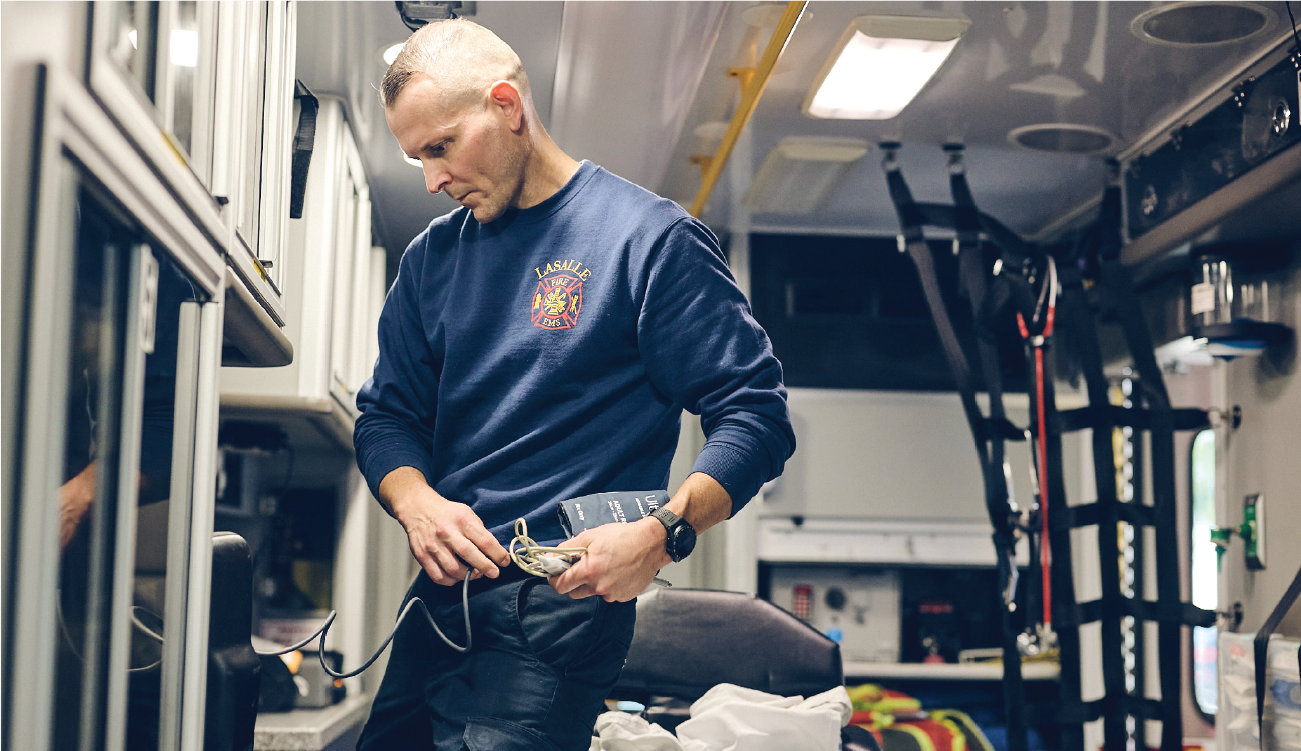
Home Is Where His Heart Is
A firefighter/paramedic/nurse anesthetist shows unparalleled drive to help his patients
Photos by Max ThomsenCommunity & Service
When he wraps up his 24-hour shift at the firehouse in LaSalle, Illinois, Jacob Szafranski, APRN, BS, CRNA, EMT-P, MS ’14, NSPM-C, heads two miles down the road for his first of two 24-hour shifts at St. Elizabeth’s Hospital in neighboring Peru. He has worked for more than 20 years as both a firefighter/paramedic first-responder and a nurse anesthetist helping clinic and hospital patients manage their pain. The jobs, he says, are complementary and enhance the care he can give in both settings.
Firefighters/paramedics responding to a 911 call don’t typically have the back story on their emergency patients, but Mr. Szafranski often does. Knowing details of their health and what medications they take helps him provide more personalized care. He thinks it lets him do a better job — and helps his patients, too.
“Just this morning, I responded as a paramedic to an urgent call, and the patient was someone I’d provided anesthesia for a month ago during a GI procedure,” Mr. Szafranski says. “For a patient in a dire situation to see a familiar face when the ambulance rolls up — I think it would be good for just bringing the blood pressure down a little bit and easing their way.”
During nursing school, Mr. Szafranski worked as an EMT at the same hospital where his mother has been a nurse for 44 years. Working in the ER and ICU, he realized he could use his nursing skills as a first responder, so he trained as a paramedic and started riding ambulances for the fire department in Hoffman Estates, a northwestern Chicago suburb.
A focus on nursing anesthesia came next. He was Rosalind Franklin University’s first certified registered nurse anesthetist (CRNA) to become board-certified in non-surgical pain management (NSPM-C, 2017), helping patients with chronic pain conditions.
Non-surgical pain management means “you get to know people over a longer time, and very few patients are asleep,” Mr. Szafranski says.
Through a post-graduate fellowship, he connected with a pain clinic near LaSalle, in the Illinois Valley, where he met his wife, also a CRNA. The pair went on to develop a mobile pain-management business that expanded access to specialized anesthesia services by traveling to medical offices and hospitals across a wide area west of Chicago.
For a patient in a dire situation to see a familiar face when the ambulance rolls up — I think it would be good for just bringing the blood pressure down a little bit and easing their way.
They settled in Peru, LaSalle’s next-door neighbor, where his wife grew up. But Mr. Szafranski still kept driving 120 miles each way to be a paramedic in Hoffman Estates. Some years, he drove 50,000 miles.
Nowadays, Mr. Szafranski is driving a lot less. He’s finally brought together the intertwining threads of his dual career in LaSalle/Peru, becoming the first firefighter/paramedic hired by LaSalle’s 175-year-old fire department as it started modernizing its firefighting staff.
Mr. Szafranski helps train RFU nurse-anesthetist residents who come through St. Elizabeth’s and other OSF HealthCare hospitals in the region. Being both a firefighter/paramedic and a nurse anesthetist has earned him a spot teaching in OSF’s new emergency-medicine fellowship for nurse practitioners and physician assistants. He trains paramedics for the LaSalle Fire Department and neighboring communities, and he has served on the National Board of Certification and Recertification for Nurse Anesthetists.
“It’s a busy life,” he says, “but I’ve always loved working where I live and taking care of my neighbors.”
Published October 2, 2026