Alice Popovici is a freelance journalist and digital nomad who writes about the intersection of science, business and culture.
Author Page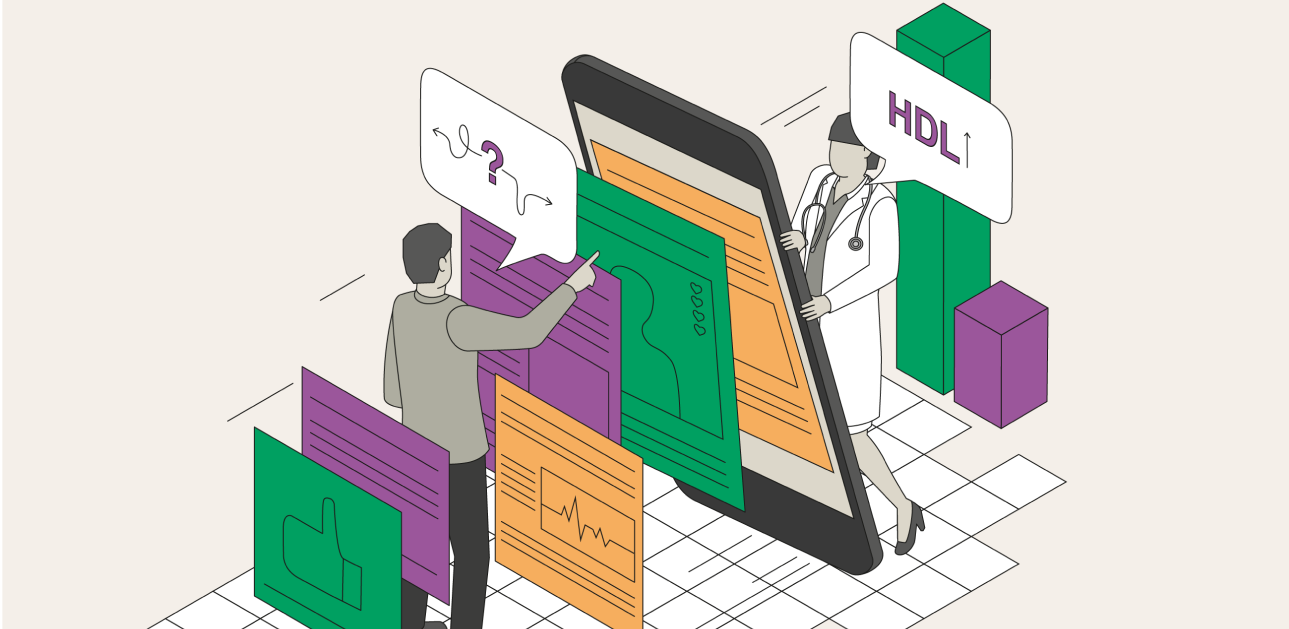
Let’s Talk Statins
Taking medication from controversy to conversation
| Illustrations by Ronny Hunger
Health & Well-Being
Most patients have heard a thing or two about statins long before their physician hands them a prescription for the cholesterol-lowering drug, which can help prevent a heart attack or stroke. Perhaps they’ve spoken with a friend who takes the medication, read a report documenting side effects such as muscle pain or memory loss, or stumbled upon a heated social-media debate about the risks associated with statin use. Some have even formed an opinion on the subject — often not a great one.
Chronic-disease-management clinicians have grown accustomed to patients’ skepticism when it comes to taking statins. Khyati Patel, PharmD, an associate professor in Rosalind Franklin University’s College of Pharmacy and an ambulatory-care specialist at Aurora Medical Center in Kenosha, Wisconsin, knows that simply telling patients to take their medication will not alleviate fear and mistrust. Instead, she tries to address their concerns by first asking them about their diet and exercise habits, and answering questions they may have about specific medications.
In her practice, where many patients have diabetes or other cardiovascular conditions, Dr. Patel has noticed patients have more reservations about taking statins compared with other medications. She believes the reluctance stems from the fact that having high cholesterol is not painful or uncomfortable. As a result, people have little motivation to treat the condition until it is too late.
 “You have an infection, you’re prescribed an antibiotic, you’re going to take it because you’re suffering,” Dr. Patel says. Statins’ benefits are harder to quantify. “It is harder to convince patients they need to be on this medication to prevent something they’re not feeling right now but could be really detrimental down the road.”
Cholesterol and cardiovascular disease
Doctors have known for decades that cholesterol — more specifically the so-called “bad” or low-density lipoprotein (LDL) cholesterol — is one of the main drivers of cardiovascular disease. But the medical community is still trying to figure out how to persuade patients to manage their cholesterol to reduce their risk of heart attack and stroke. While statins are among the most effective and inexpensive tools for managing cholesterol, they have been the subject of ongoing controversy since they were introduced in the late 1980s, both for adverse effects some users experience and for the perceptions they are being heavily promoted by drug companies and even prescribed to patients who may not need them. The debates play out in the media, and even clinicians are sometimes divided on how, when and to whom statins should be prescribed.
In their newly released medical guidelines, the American Heart Association and the American College of Cardiology lowered the recommended age for cholesterol screening from 40 to 30, promising to reignite the debate surrounding statins. Meanwhile, clinicians underscore the need for meaningful conversation about statin benefits vs. risks, along with the dangers of social media–fueled misinformation.
“I’m always trying to provide a little re-education around [statins], because a lot of times, people will come in with one belief, like, ‘I’ve heard they always cause muscle aches,’” says David Schopfer, MD ’04, a cardiologist at the National Heart, Lung and Blood Institute in Bethesda, Maryland. “I do think people are almost looking for it … ‘Does anything hurt? Does any joint or muscle bother me?’”
While Dr. Schopfer notes there are minor risks of certain side effects associated with statins, he agrees with the consensus that the benefits of statins outweigh the risks. He asks patients to come to him with their concerns rather than stop their treatment altogether.
“I’m going to try to work with them to find a solution rather than immediately stopping [the medication] and never trying it again,” he says. “Ultimately, I want you to be healthy; I don’t want you to be miserable.”
Lack of nuance in the conversation creates an information void that pushes some patients to search for answers online, feeding the misinformation loop.
Understanding the medication
Alternately described as a “wonder drug” and an “internet villain,” statins have been shown to reduce between 30% and 50% of cholesterol in the blood by interfering with the liver’s production of LDL cholesterol, which would otherwise cause plaque buildup, narrow arteries and lead to heart disease. For patients who fall in a high-risk category for cardiovascular disease, either because they have already had a heart attack or stroke, or have other risk factors, doctors will generally prescribe high-intensity statins, such as atorvastatin and rosuvastatin. The other medications in the statin family — simvastatin, pravastatin, pitavastatin and lovastatin — are considered moderate to low intensity. For patients merely suspected of being high risk, clinicians rely on a formula that calculates one’s risk of having a heart attack or stroke in the next 10 years based on variables including age, height–weight ratio, blood pressure, kidney function and family history of heart disease.
Dr. Schopfer says the updated guidelines for determining cardiovascular risk give doctors an opportunity to screen and potentially treat even more people who are at risk of heart attack and stroke.
“You could be high risk and in your 30s; that’s what we do know,” he says. “Say you carry a gene, or you have a very strong family history of heart attacks at an early age. These kinds of things could make you high risk, and therefore, the treatment is really more around treating people who are at high risk of an event, regardless of whether you’re 35 or 45 or 55.”
For people who do not tolerate statins due to adverse side effects or take other medications that interact with statins, there are a few alternatives. While other medications, such as ezetimibe, may not meet with as much resistance from patients as statins, they also offer milder cholesterol-lowering benefits. Newer medications, such as bempedoic acid, offer cholesterol-lowering benefits that are just slightly lower than high-intensity statins and are sometimes used as supplemental treatment.
PCSK9 inhibitors, injectable drugs that lower cholesterol levels by up to 50% with fewer reported side effects than statins, also come with an annual price tag nearing $6,000. They are currently approved for people at high risk of atherosclerotic cardiovascular disease (ASCVD) and commonly prescribed in addition to statins to further reduce risk.
Clinicians who treat patients with heart disease and those at risk for developing it say they keep returning to statins because they are effective, inexpensive and provide benefits beyond lowering cholesterol.
 “Those benefits include lowering the inflammation and stabilizing the plaque in the arteries, so the plaque doesn’t rupture,” Dr. Patel says. “That’s why it’s really important to put a patient on even the smallest possible, or maximally tolerated, statin dose.”
From controversy to conversation
As side effects go, Drs. Patel and Schopfer say the concerns they hear most frequently from patients taking statins have to do with muscle pain, followed by memory loss, dementia and the risk of developing diabetes. Both doctors point to studies indicating that statins’ negative effects on cognition are inconclusive, and mild cases of memory loss are rare and reversible. There is, however, a small risk that patients taking high-intensity statins could develop Type 2 diabetes, which should be weighed against the fact that statins also prevent heart attacks and strokes in people with diabetes.
In patient interactions, listening is key.
“If somebody tells you statins cause dementia, and your initial instinct is to say, ‘No, that’s not true,’ you’ve basically built a wall,” says Professor Sneha Srivastava, PharmD, BCACP, CDE, associate director of pharmacy-skills education in RFU’s College of Pharmacy and a primary-care clinical pharmacist at the Captain James A. Lovell Federal Health Care Center Veterans Affairs Clinic in Kenosha, Wisconsin. “There’s nowhere for that conversation to go.”
Dr. Srivastava says medical professionals often do not adequately explain to patients the risks and tradeoffs of taking statins, choosing instead to focus on the medication’s significant life-saving benefits. This lack of nuance in the conversation creates an information void that pushes some patients to search for answers online, feeding the misinformation loop.
Dr. Srivastava strongly recommends statins for patients who have diabetes or other risk factors for cardiovascular disease. But she also suggests at least one lifestyle modification.
“I try to focus, rather than on restriction, on what can you add [by] having that conversation,” she says. After learning more about a patient’s dietary habits, she may ask them: “Are you willing to eat oatmeal three times a week instead of your sausage sandwich?”
Dr. Srivastava says that, based on research, lifestyle changes — such as following a Mediterranean diet, a vegan or vegetarian diet, or a DASH (Dietary Approaches to Stop Hypertension) diet that limits sodium — can provide significant health benefits alongside statin treatment. For some patients with a low risk of cardiovascular disease, lifestyle changes can potentially serve as an alternative to statins. Yet clinicians seldom emphasize the importance of these lifestyle modifications in their conversations with patients. She recommends the website NutritionFacts.org, founded by Michael Greger, MD, who is also one of the founders of the American College of Lifestyle Medicine, as a reliable resource on using nutrition to manage or prevent chronic disease. The website provides answers to common questions in generally understandable language.
“We in healthcare don’t spend enough time with patients — or I should say, by the design of healthcare, there’s not enough time in the room to address patient concerns,” Dr. Patel points out. “I’d rather they come to the right source to discuss their concerns and get the right answer than try to find it on the internet or social media, where there’s a lot of fearmongering, misinformation and disinformation.”
In episode 180 of “HelixTalk,” the College of Pharmacy podcast she co-hosts, Dr. Khyati Patel takes a deep dive into the different types of statins, their benefits and limitations, and how they stack up against the other medications.
Published October 2, 2026