Sara Skoog started college as pre-med, switched her major to English and has spent 20+ years writing about medical education and health care. Hobbies include baking, crosswords and not watching sports.
Author Page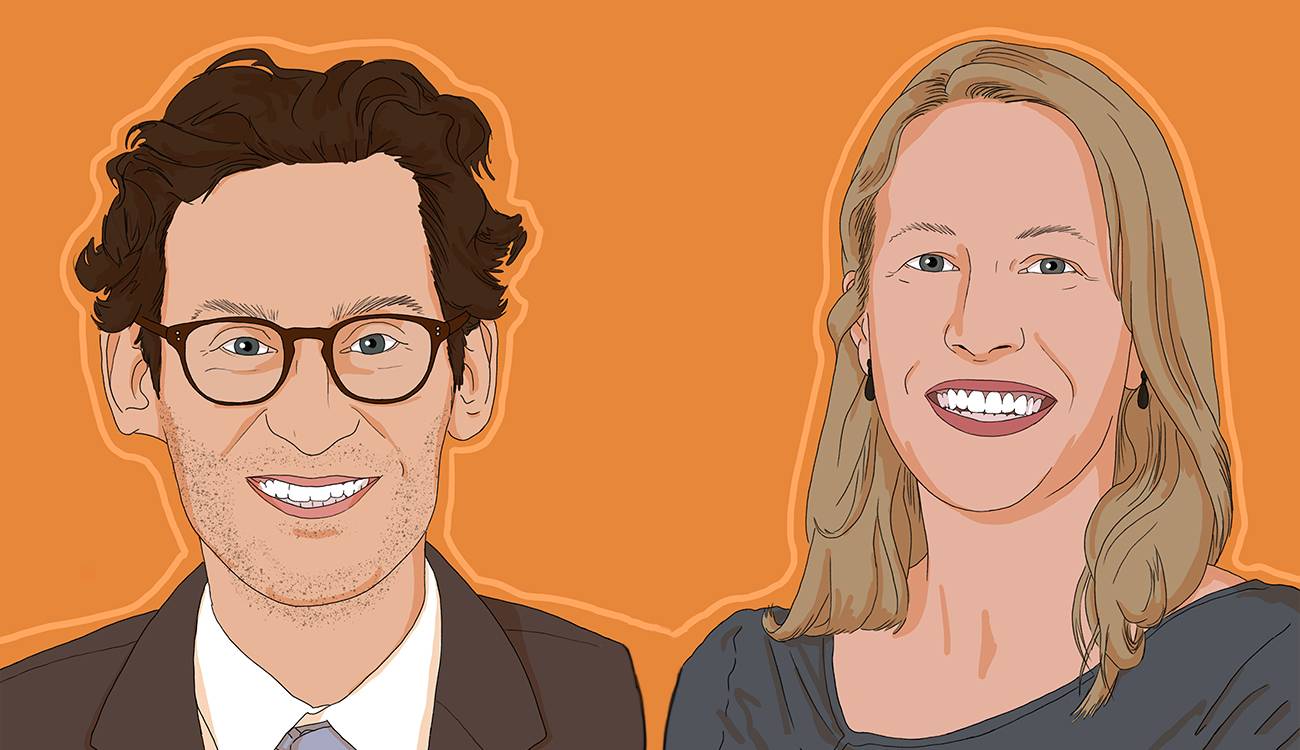
Interprofessionalism plays out in a clinical study
Illustrations By Michelle KondrichNoah Rosenblatt, PhD, associate professor, Center for Lower Extremity Ambulatory Research (CLEAR), Dr. William M. Scholl College of Podiatric Medicine, and Kristin Schneider, PhD, FSBM, professor and chair of psychology, College of Health Professions, are associate deans of research for their respective colleges. They worked together on a clinical research study called “Mixed methods analysis of an interdisciplinary intervention to promote balance confidence in lower limb prosthesis users,” along with several other RFU faculty members. Here, they reflect on their interprofessional approach to the study.
Noah Rosenblatt: The idea of collaboration on a study like this started for me around 10 years ago, not long after I joined the university. My work was in fall prevention, and I had this particular interest in fear of falling.
Kristin Schneider: I think we connected on some areas you were interested in with respect to movement and barriers to physical activity. That spoke to me as a health psychologist — the connection between mental health and activity.
Through this study, I talked to patients in a way I don’t typically do on a daily basis, and witnessed their improvement and growth.
NR: That sounds right. I had a grant on falls and obesity that included studying the physical activity differences of obese and non-obese individuals, and the data found that fear of falling was one of the strongest predictors that affected activity levels. I think that finding, and my interest in working with amputees, who often face obesity after limb loss, led us to think about studying balance confidence in amputees who use a prosthesis.
KS: Yes! We met in your old office, and you showed me data on how fear of falling in folks with a lower limb amputation is not associated with their actual physical ability. To me, that says we have to address their fear of falling while also working to improve their balance, which brings PT (physical therapy) into the picture. What’s lovely about this intervention is psychology and PT co-treating a patient in one session. That’s very novel. Drs. Kavork Hagopian (DPT ’14), Sarah Haag (DPT ’07, MS ’08) and Sara Kraut (DPT ’01) brought in expertise I didn’t have as a psychologist.
NR: There’s also the connection to the VA. Because the project was funded through a grant from the Department of Defense, bringing in the veterans was important. That’s where Dr. Chris Reddin came in, as a mental-health nurse practitioner with the VA at Lovell [Federal Health Care Center] just down the street from us. So we had the psychology aspect, and the PTs monitoring physical movements on the treadmill …
KS: And you brought in the games!
NR: Oh right, the games!
KS: You added a really cool gaming aspect to the movement exercises on the treadmill, which is another very novel aspect. The games gave the patients something to focus on other than any anxiety they had as they walked on the treadmill.
NR: To be honest, I don’t think I was aware the games came with the treadmill when I got it.
KS: No way! I didn’t know that.
NR: Or maybe I did, but I didn’t get the treadmill for the gaming. I had never done anything with that sort of technology. So once I learned the treadmill included some games, I said, “Well, let’s use what we’ve got.”
KS: The entire team believed in the importance of addressing both physical and mental health for whole-person care. I don’t do much clinical work now. I’m focused on research and teaching. Through this study, I talked to patients in a way I don’t typically do on a daily basis, and witnessed their improvement and growth.
NR: I know what you mean. I’m thinking of that one patient who worried about climbing ladders, and seeing that “Aha!” moment from him in real time, addressing his fear, was really informative and exciting to me. I’d like to see more of those.