Kim Westerman, MFA, EdD, is a travel and wellness writer, coffee expert and longtime university writing teacher based in Berkeley, California.
Author Page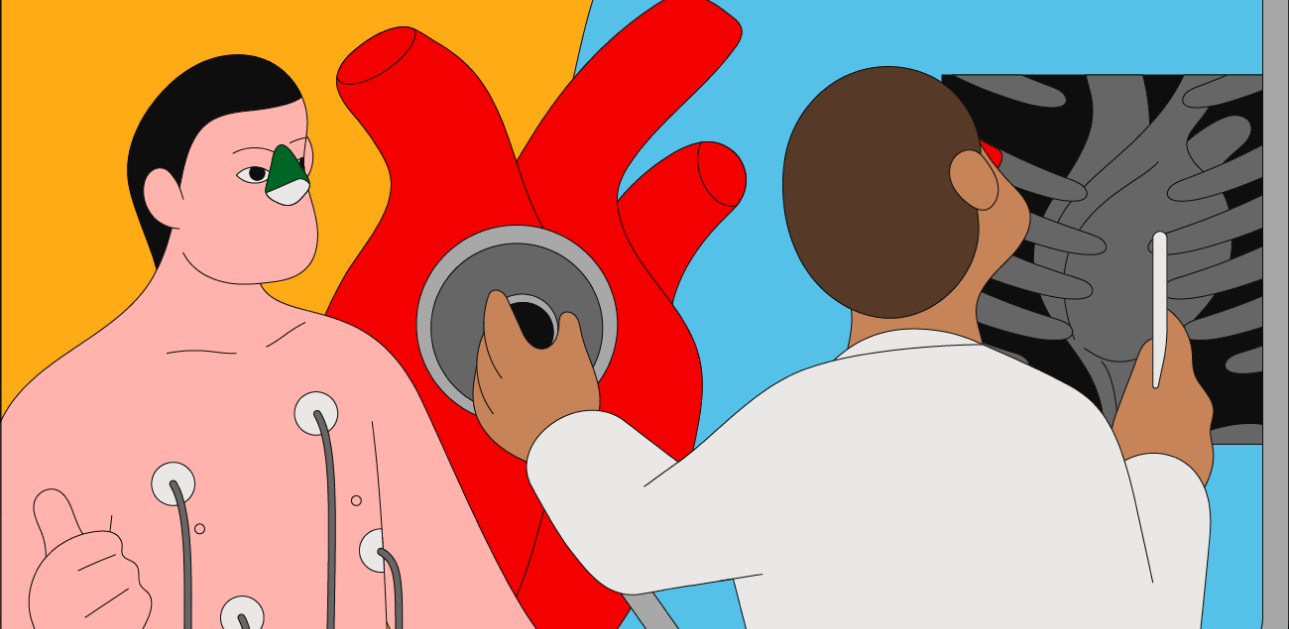
The Anatomy of a Cardiology Specialty
Mapping the journey to proper cardiovascular care
| Illustrations by Camilo Huinca
Health & Well-Being
For many patients, the journey into cardiovascular care begins not with a dramatic heart attack, but with something subtle: unusual fatigue climbing the stairs, a fluttering heartbeat during the night, shortness of breath during a walk or a blood pressure reading that suddenly seems harder to control. In these moments, patients enter a medical system layered with increasingly specialized expertise.
Behind every title — internist, cardiologist, electrophysiologist, interventional cardiologist, cardiothoracic surgeon — lies a specific sequence of education, certification, credentialing and clinical experience. (See the sidebar, “Cardiologist Credentials Explained” for more explanation) Understanding these distinctions can help demystify referrals, clarify what different specialists actually do and empower patients to ask informed questions about their care.
Future cardiologists move through an educational ecosystem that mirrors the increasingly specialized nature of modern cardiovascular medicine. From primary care physicians to fellows training in advanced interventional procedures, the system is designed to direct patients toward the right level of expertise at the right moment. The path is not always linear; neither is heart disease.
Fellow on the Front Lines
For Anish Munagala, MD, cardiology was never just a career choice. Growing up in a family filled with physicians after his parents emigrated from India, medicine surrounded him from childhood.
“I dressed up as a doctor for, like, 10 straight Halloweens,” he says with a laugh.
The road there wasn’t linear. After graduating early from Saint Louis University, he chose Ross University in Dominica. For Dr. Munagala, cardiology was the only specialty that combined the intellectual clarity of physiology with the rare satisfaction of immediate results.
During his RFU interventional cardiology fellowship at Chicago’s Mount Sinai, Dr. Munagala spent his days (and nights) inside one of medicine’s most high-pressure environments: the cardiac catheterization lab.
As the sole interventional fellow at his hospital, he remained on call around the clock for emergencies, including heart attacks, temporary pacemaker placement and cardiac tamponade (a life-threatening heart emergency when excess fluid builds up inside the pericardial sac). A typical day began with reviewing imaging, labs and procedural plans before heading into angiograms, stent placements and high-risk interventions.
Despite the intensity, he remains energized by the field. “It’s one of the few areas in medicine where you can see instant results,” he says. “A patient comes in with crushing chest pain, you open the artery, and they immediately feel better.”
This past summer, Dr. Munagala transitioned from fellow to attending interventional cardiologist, continuing his work in the same Chicago hospital system, Mount Sinai, where he trained.
First stop: primary care
Most patients do not receive heart care first in a cardiologist’s office. “Typically, a symptom is what drives a patient to their primary-care physician,” says Sandeep Khosla, MD, interventional cardiologist and Cardiology Fellowship program director at Rosalind Franklin University. The first evaluations usually happen in the office of a family medicine physician or an internist, who may order an EKG, basic labs, an echocardiogram or rhythm monitoring before any specialist is involved.
Arpita Patel-Mehta, MD, MPH, discipline chair and education director of family and preventive medicine at RFU’s Chicago Medical School, describes continuity of care as “the bread and butter of family medicine.” Some of her patients span multiple generations of the same family: grandparents, parents and children she has known for decades.
That long-term relationship fundamentally shapes how cardiac symptoms are interpreted. “A cardiologist takes care of the heart,” Dr. Patel-Mehta says. “As a primary-care physician, I take care of the person who has that heart.” In practical terms, that means managing large portions of cardiovascular care directly, including hypertension, high cholesterol, stable coronary artery disease and even some arrhythmias, while also distinguishing cardiac emergencies from symptoms rooted in stress, anxiety or grief.
“Not every chest pain is heart disease–related,” Dr. Patel-Mehta says. “But it deserves a thoughtful evaluation.” A physician who has cared for someone for 20 years may recognize when symptoms reflect a dangerous change or when fear, itself, is driving concern. “I know the patient. I know their backstory, their stressors, their health history. The emergency room doesn’t know any of that.”
The goal, Dr. Patel-Mehta says, is not to refer everybody to a specialist; “it’s to refer at the right time to the right person.”
The right care at the right time
The referral process can seem mysterious. What exactly is a cardiologist evaluating? What determines whether a patient stays with a general cardiologist or advances to a subspecialist? The answer depends on the nature and severity of the underlying problem.
Broadly speaking, cardiologists manage a wide spectrum of cardiovascular disease, including coronary artery disease, heart failure, arrhythmias, valvular heart disease, congenital heart disease, hypertension, and cardiovascular complications related to diabetes, kidney disease, pregnancy or systemic illness.
A patient with mildly elevated blood pressure and occasional palpitations might continue seeing a general cardiologist for years, while a patient with severe coronary artery disease could rapidly move from a stress test to coronary angiography and bypass surgery within days.
The complexity of modern cardiovascular medicine has transformed cardiology into an increasingly subspecialized field. That specialization begins with extensive training.
The complexity of modern cardiovascular medicine has transformed cardiology into an increasingly subspecialized field.
The path to becoming a cardiologist
The path to cardiology is one of medicine’s longest. After four years of college and four years of medical school — where clinical rotations in the third year often spark the specialty decision — physicians enter a three-year internal medicine residency, caring for hospitalized adults across the full spectrum of disease.
Residency is followed by board-certification examinations. Only then can physicians pursue a cardiology fellowship: three additional years of specialized cardiovascular training. Fellowship programs are intensely competitive; Dr. Khosla notes that his program receives more than 600 annual applications to fill four positions (three in general cardiology and one in interventional cardiology).
What draws physicians through years of additional training is often the field itself. For Dr. Khosla, now 28 years into a career that has required constant call coverage and sacrificed more than a few family milestones, the pull remains the same: “When I started training, many patients automatically went to open-heart surgery. Now interventional cardiology can handle much more complex diseases.”
Choosing the right specialist
One of the hardest questions for patients is understanding when a general cardiologist is enough and when more specialized care is needed.
- General cardiologists are typically appropriate for patients dealing with hypertension, cholesterol management, stable coronary artery disease, preventive cardiac care, mild heart failure, chest-pain evaluation or routine arrhythmias.
- Interventional cardiologists become involved when patients experience heart attacks, have severe coronary blockages, or require procedures such as angioplasty and stenting.
- Electrophysiologists manage complex rhythm disorders, including atrial fibrillation, dangerous arrhythmias and ablation procedures, as well as pacemakers and implantable defibrillators.
- Structural heart specialists focus on minimally invasive valve procedures, such as transcatheter aortic valve replacement (TAVR).
- Heart failure and transplant specialists care for patients with advanced disease requiring mechanical support or transplant evaluation.
- Cardiothoracic surgeons continue to play an essential role in bypass surgery, open-heart procedures and highly complex structural disease.
Cardiologist credentials explained
When you look at a cardiovascular specialist’s biography, there is typically a slew of credentials and abbreviations to decipher. Here’s what they mean for patients:
Primary Medical Degrees
MD (Doctor of Medicine)/DO (Doctor of Osteopathic Medicine): Both are fully licensed physicians. A DO also completes training in osteopathic manipulative medicine.
Post-Graduate Training
Internist/Internal Medicine: After medical school, future cardiologists complete a three-year residency in internal medicine, learning to manage complex adult conditions before subspecializing. Following residency, a physician may also pursue a cardiology fellowship.
Board-Certified: Indicates the physician passed rigorous national exams after completing accredited training. Most hospitals require board certification to grant practice privileges. Certification must be maintained through continuing education and periodic re-examination.
Professional Designation
FACC (Fellow of the American College of Cardiology): Recognizes professional achievement and active involvement in a major cardiovascular organization.
FCCP (Fellow of the American College of Chest Physicians): Recognizes expertise in pulmonology, critical care, and related cardiovascular and thoracic medicine.
The key is recognizing that treatment by a specialist simply means more focused expertise for specific conditions. A highly skilled general cardiologist or even a primary-care physician may be exactly the right doctor for many patients.
Or maybe both. “Medicine has become increasingly collaborative,” Dr. Khosla says. “The best outcomes often emerge from coordinated teams rather than isolated experts.”
Cardiology has been transformed by technology, subspecialization and decades of hard-won expertise. For patients navigating it for the first time, the system is less intimidating when its logic is clear: Understanding that anatomy — who does what and when — is what turns a referral from a mystery into a map.
Published October 2, 2026