Kim Westerman, MFA, EdD, is a travel and wellness writer, coffee expert and longtime university writing teacher based in Berkeley, California.
Author Page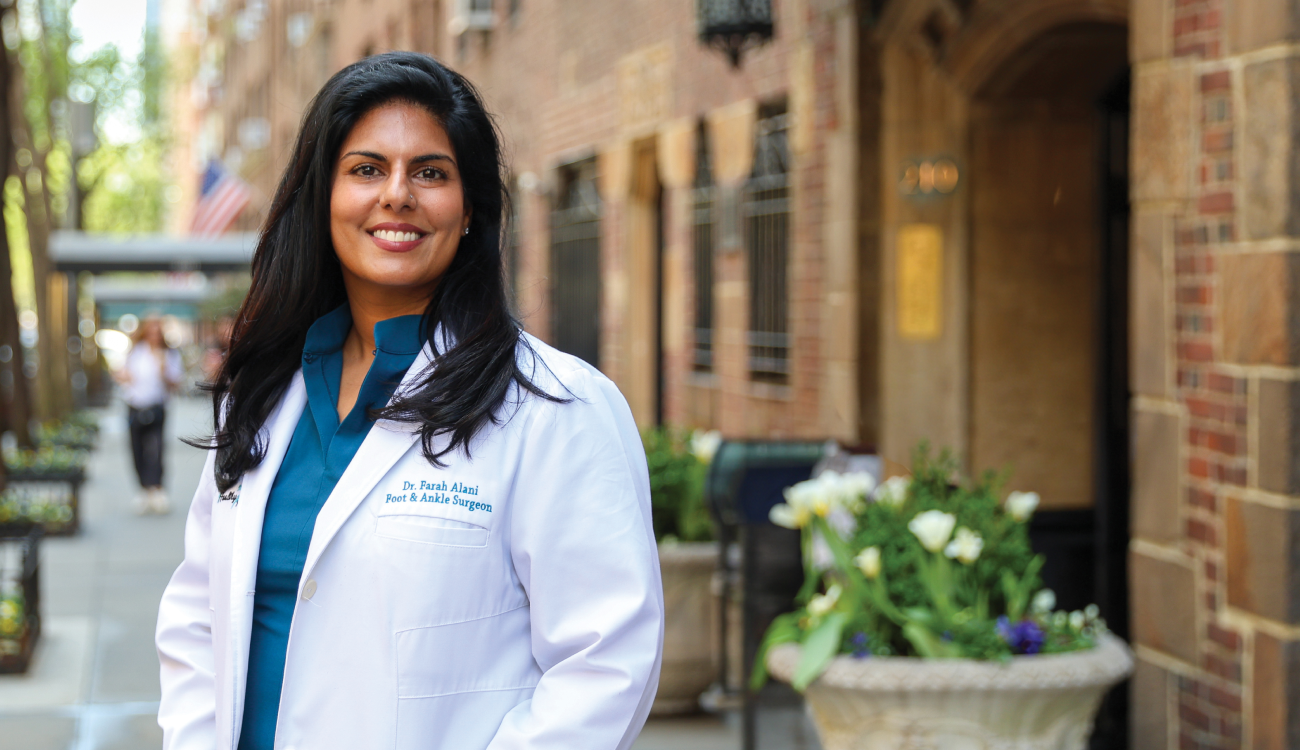
Best Foot Forward
Photo By Ken PaoCommunity & Service
Farah Alani, DPM ’11, had taken her LSAT and planned to spend a summer shadowing an immigration and refugee lawyer in Kampala, Uganda. When those plans fell through because of safety concerns for her intended mentor, she connected with an HIV/AIDS education organization and observed her first surgery: a procedure that allowed an 8-year-old boy, orphaned by AIDS and supporting younger siblings, to wear shoes for the first time, enabling him to walk to the market.
“I was able to see how one small intervention could help that child better provide for himself and his family,” Dr. Alani says. “That experience inspired me to explore medicine.” Soon after, she enrolled in RFU’s Dr. William M. Scholl College of Podiatric Medicine.
Dr. Alani grew up in a family rooted in community service, and she got the opportunity to practice those values early on in her medical training. In podiatry school, she volunteered with the nonprofit Liga International (also known as the “Flying Doctors of Mercy”), which flew doctors to Mexico to treat rural patients with little access to care, using churches as makeshift clinics. The work sparked a career-long commitment to preventive care as means to help patients stay healthy and mitigate bigger issues.
Now a New York City–based podiatric physician and surgeon, Dr. Alani has logged years of volunteer leadership within her Ismaili Muslim community through the faith-based Aga Khan Health Board, which focuses on disease prevention and community education; its work complements formal healthcare systems rather than replacing them. In past roles, including several years as board chair, she helped oversee community-based health initiatives across more than a dozen centers in the northeastern United States, all powered by volunteers.
The approach was intentionally practical. “They weren’t formal clinics,” Dr. Alani explains. “There was a doctor or nurse there once a month; we took blood pressure and blood sugar readings and wrote medication refills. If someone needed something urgent, we were there.” These predictable pop-up health touchpoints addressed a reality Dr. Alani saw repeatedly: When families are focused on housing, work and immigration concerns, preventive care is often delayed, sometimes with devastating consequences.
“Because people knew we would be there on the first Friday of every month, we could solve the small things,” she says. “And if there was ever a bigger issue, we made sure they were connected to proper follow-up care.” Preventing crises, she adds, often comes down to closing small gaps before they widen.
Dr. Alani continues to serve the same communities in a different capacity, leading community-building initiatives across Aga Khan’s 14 centers in the Northeast. Her focus has expanded beyond health care to include education, integration and social connection — particularly for newly arrived families from Central Asia and other regions. The work ranges from mentoring and educational advocacy to social spaces that combat isolation, especially among elders.
“Our goal is to give every member of the community a sense of belonging and purpose,” she explains. “People should be able to give or receive, depending on what they need.”
In parallel, Dr. Alani opens her professional world to others, offering shadowing opportunities through her practice to students of all ages exploring careers in medicine. Access, she believes, should be offered freely.
Balancing clinical work, volunteer leadership and, now, life as a new mother requires constant recalibration. Across roles and years, her commitment remains steady: showing up consistently, building systems of care and ensuring community is always the cornerstone.
Published July 5, 2026