
The Business of Better Healthcare: A Conversation with Dr. John Shufeldt
View Related Pages
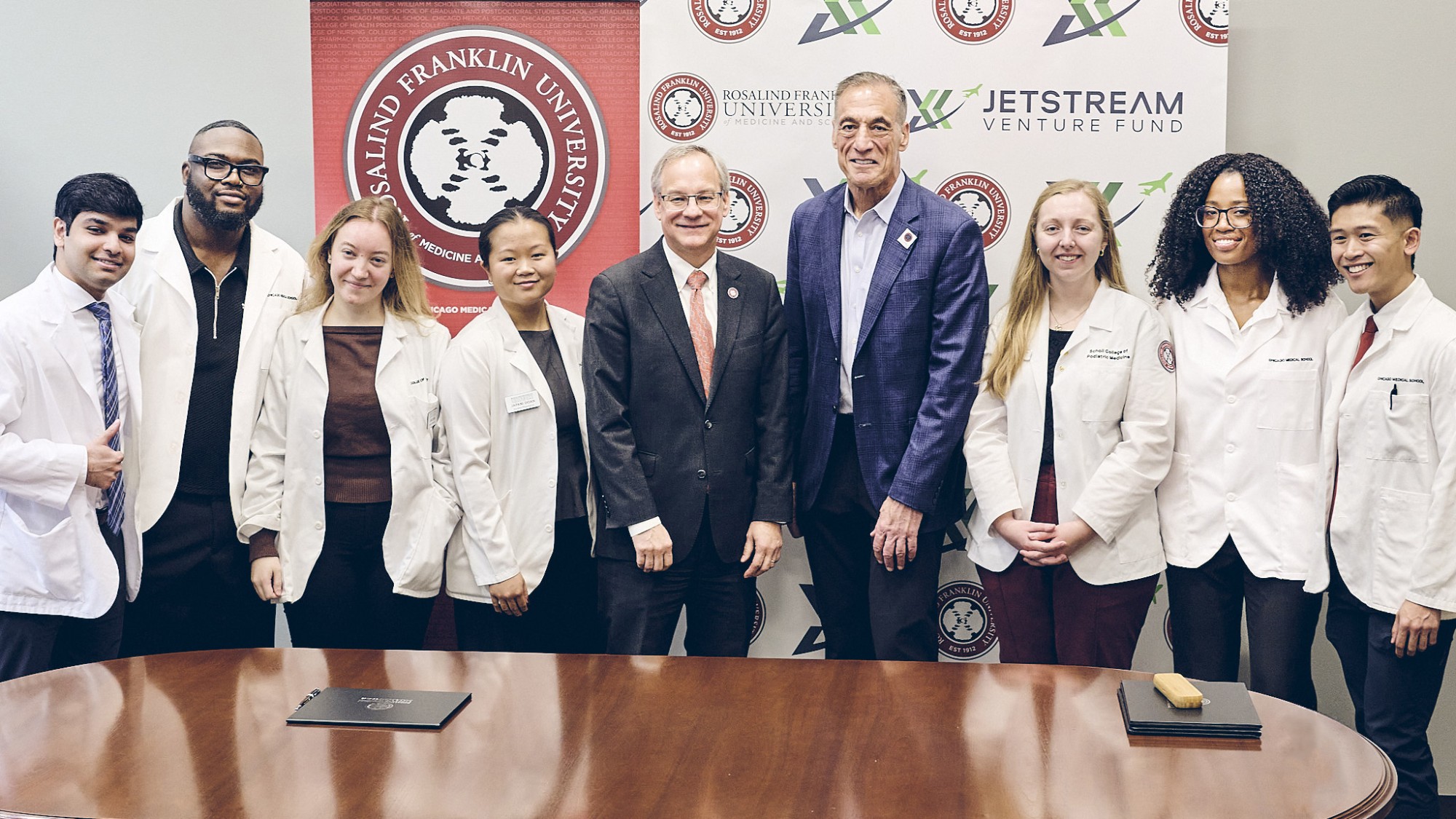
Chicago Medical School alum, physician and healthcare entrepreneur encourages RFU students to question assumptions, embrace uncertainty and recognize opportunities to improve patient care.
Some of the most promising ideas for improving healthcare begin with a simple observation: There’s a better way to do this.
John Shufeldt, MD ’86, JD, MBA, didn’t set out to become a successful healthcare entrepreneur. Dr. Shufeldt, a venture capitalist who invests in early-stage healthcare companies developing innovative technologies and solutions to improve patient care, had no formal business training when he began identifying opportunities to solve problems in healthcare.
Now an experienced healthcare entrepreneur and founder of Xcellerant Ventures, Dr. Shufeldt encourages aspiring innovators to look at challenges with fresh eyes, take risks and embrace failure as part of the process.
Following the signing of a new partnership between Rosalind Franklin University of Medicine and Science (RFU) and Xcellerant Ventures to expand entrepreneurship education and support the development of healthcare innovations, Dr. Shufeldt met with RFU students to share insights from his own entrepreneurial journey.
“Failure is just another day,” the Chicago Medical School alum told the students during a wide-ranging conversation about medicine, entrepreneurship and venture capital. Passionate about mentoring the next generation of healthcare innovators, Dr. Shufeldt offered practical guidance on transforming promising ideas into successful business ventures
An avid reader, Dr. Shufeldt also reflected on some of his favorite books that shaped his thinking about how curiosity, unconventional thinking and a willingness to challenge assumptions can lead to new approaches to healthcare.
[This conversation has been edited for length and clarity.]
Finding opportunities to innovate
Agbai Kalu, CMS ’28: “How can we as students and healthcare professionals dive into the world of entrepreneurship?
Dr. Shufeldt: As part of my company, we look to invest in solutions for problems that are common, recurring and expensive to solve. What are the solutions to those problems?
The beauty of going through medical training, as you are, is that you have this fresh set of eyes. So, you may see something that I’ve missed all along.
People tell me I make a great venture capitalist because I have outstanding pattern recognition, I can see things that are coming. But I don’t think that’s true. The beauty of where all of you are is you have this fresh set of eyes to see new things.
Surrounding yourself with people who challenge you
Shelby Hicks, CMS ’29: I believe we’re a product of our environment. That said, what is your advice for how to get yourself in rooms so you can be around the right people?
Dr. Shufeldt: There are two ways. You’ve probably all heard that your life is all about the five people you surround yourself with.
I’ve looked at people and thought, “Hey, I want that trait,” and I go learn that trait by reading books by experts and trying to emulate them.
You want to be the dumbest person in the room. Surround yourself with a lot of smart people, because a rising tide raises all boats.
Put yourself in a room where you’re uncomfortable and don’t be afraid to look foolish.
Staying curious across disciplines
Ingrid Frayer, SCPM ’28: I went to an alumni event where someone told me to remain inquisitive. What kind of mindset should we have moving forward in our careers?
Dr. Shufeldt: That’s so important, to be innately curious about really everything. I’ve found there are people who are narrow and deep, and God bless them, but I’m an inch deep and a mile wide.
But it’s hard to put together the intersection of two disciplines where someone might not see them together. For example, there’s a book by Malcolm Gladwell [“Blink: The Power of Thinking Without Thinking”] that talks about which doctors were more likely to get sued for malpractice based on their tone of voice during consultations. It turns out women were less likely to get sued, because, in general, they’re more compassionate, they have a different tone of voice.
So, one of my earlier startups was this idea where I went to an insurance company and said I’ve got a personality test that, based on scores, predicts doctors who are more and less likely to get sued. I said, reduce the premiums of people who score well and I want a piece of it. I had this idea and I made it work.
Looking back without regrets
Noel Vincent, CMS ’28: Classic time machine question: If you were a third-year student again, what would you do differently?
Dr. Shufeldt: I don’t know if I would’ve done anything different. Søren Kierkegaard said, “Life can only be understood backwards, but it must be lived forwards,” and it’s really that. So, I don’t know if I would’ve done anything differently. I certainly would’ve done emergency medicine again.
Recognizing problems worth solving
Richard Moraga, CMS ’28: You earlier said you initially wanted to go into academics and then shifted to entrepreneurship. Can you explain why you chose the path you did?
Dr. Shufeldt: I always tell the story about when I first started in emergency care and this guy came into the emergency room and said he was almost stung by a bee, and I said, “Wait a minute, you said you were ‘almost’ stung by a bee?” and in the back of my mind I’m thinking, why are you here?
He said, “So what happens if I almost get stung again?” and I said, “Then you should almost come back in.”
This was before the days of urgent care, and this was the moment I realized we need to unburden the emergency department because they’re gonna wake up and realize they don’t want to be paying a person like me to treat their colds. Now, the urgent care concept was a complete failure. ERs are still overrun with colds and flus, so we didn’t really do anything except create another outlet of care for folks.
But it was probably at this moment that I realized this was a lot more fun than writing papers and academia.”
For RFU students, recognizing that “there’s a better way to do this” can be the beginning of an entrepreneurial journey. The university’s partnership with Xcellerant Ventures aims to help aspiring innovators explore what comes next.
To learn more about Dr. Shufeldt and explore his curated list of favorite reads, including books that have inspired his approach to entrepreneurship, leadership and innovation, visit johnsbooks.com.