
View Related Pages
Economic Contribution of Rosalind Franklin University
Introduction
Rosalind Franklin University (RFU) contributes to the economy of North Chicago and the region via its operations and faculty/staff, retaining student spending and construction projects.
This report presents the results of economic impact analysis for Rosalind Franklin University, using the nationally recognized economic modeling software IMPLAN. The results are presented in terms of direct, indirect and total effects on employment, compensation, value added and output. These impacts are presented for North Chicago and a commuting region consisting primarily of Lake County and northeastern Cook County.
Employment in this study refers to total full- and part-time employment and does not necessarily translate to FTEs. Compensation includes wages, salaries and fringe benefits. Value added measures contribution to regional GDP — it includes compensation, proprietor income, property income or profits, and taxes on production. Output is the total value of goods produced and services provided, including value added and input costs such as energy and materials. Next are definitions of the economic impact types included in this study.
Economic Impact Definitions
Direct effects are specific to economic activities specifically attributable to RFU. Examples include student spending, the value of patient care provided, and the value of construction projects.
Indirect effects represent broader economic activity that occurs as a result of the direct effect. Direct effects of the project ripple across the region as companies purchase from suppliers and employees at those companies spend their wages. An example of an indirect effect would be an increase in retail sales as workers who do business with RFU students spend their wages in the region.
The total effect represents the direct and indirect effects combined. A multiplier is calculated as the total effect divided by the direct effect, it provides a measure of the number of jobs supported in the region as a result of RFU’s presence.
Region Definitions
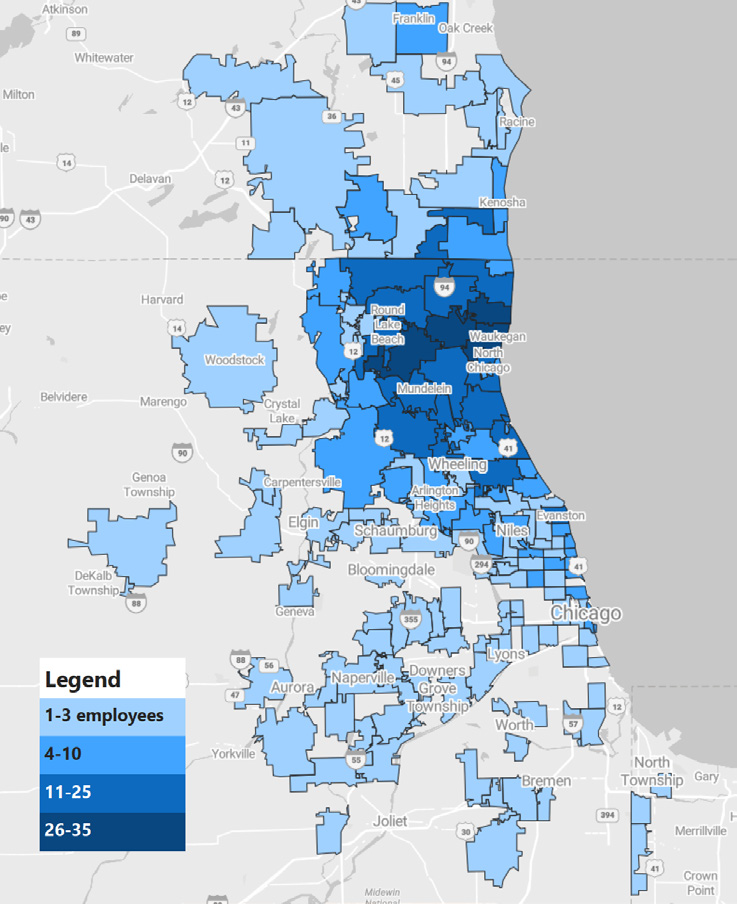
RFU commuter flows are fragmented, but the largest share are in Lake County and Cook County. The majority of RFU employees live in Lake County and about 33% of workers live in Cook County. About 3% of commuters live in DuPage County, fragmented across many communities each with less than 3 workers. About 10% of workers live outside of Illinois. In the interest of defining a compact and contiguous region, in this study, the region is defined as Lake County and all Cook County ZIP codes with one or more RFU employees.
Operations & Faculty/Staff
The largest share of RFU economic impacts comes from its operations, which includes instruction, student services, research, and patient care. In fiscal year 2024, RFU spent a total of $147.8 million, including 1,267 employees and $79 million in personnel. RFU spent $25.1 million on research, which includes 207 jobs and $16.8 million in value added for the regional economy. Value added includes employee compensation, proprietor income, taxes on production, and property income or profits.
About 182 jobs and $23.7 million in value added are generated through the indirect and induced effects, which include business-to-business spending from RFU’s vendors and spending of wages by affected employees. The university has a larger multiplier than would be typical for an institute of higher education, due to its distinct research and patient care activities.
Economic Impact of RFU Operations and Faculty/Staff
| Impact Type | Jobs | Compensation | Value Added | Output |
|---|---|---|---|---|
| Direct | 1,267 | $79,370,000 | $103,898,000 | $147,801,000 |
| ↳ Research | 207 | $12,633,000 | $16,883,000 | $25,081,000 |
| ↳ Patient Care | 58 | $6,049,000 | $7,929,000 | $14,134,000 |
| Indirect | 182 | $12,175,000 | $23,689,000 | $38,007,000 |
| Total | 1,448 | $91,546,000 | $127,587,000 | $185,809,000 |
| Multiplier | 1.1 | 1.2 | 1.2 | 1.3 |
Source: IMPLAN, 2023.
By far the most-impacted industry by RFU operations and faculty/staff is real estate, with $7 million in indirect value added. This includes owned and rented dwellings for impacted workers. The second-largest share of value added was in health care, with $2.4 million. RFU operations indirectly added $1.7 million in value added for finance and insurance.
Student Spending
RFU had 2,021 students enrolled for 2024–2025. Based on estimates from Financial Aid, living expenses at RFU total $25,200 per student. Students directly spend about $50.9 million in the region each year, including housing costs, utilities, travel, and retail purchases. Living expenses are higher for students with dependents, and lower for those living with parents. The $25,200 estimate was modeled as a midpoint. Detailed spending patterns are estimated based on the Bureau of Labor Statistics’ Consumer Expenditure Survey. For example, the living costs from Financial Aid show estimated total utility costs, while the Consumer Expenditure Survey was used to determine which proportion of utility costs is spent on electricity, internet, etc.
Direct student spending supports 206 jobs and contributes $40.9 million in value added. An additional 40 jobs and $5.6 million are generated through the indirect effect, which includes supply chain purchases by companies who do business with students, and by workers of those companies spending their wages. For every $1,000 spent by an RFU student, an additional $200 in output is generated in the economy of Lake County and northeast Cook County.
Impact of RFU Student Spending
| Impact Type | Jobs | Compensation | Value Added | Output |
|---|---|---|---|---|
| Direct | 206 | $9,061,000 | $40,930,000 | $50,897,000 |
| Indirect | 40 | $3,152,000 | $5,567,000 | $8,807,000 |
| Total | 245 | $12,213,000 | $46,497,000 | $59,704,000 |
| Multiplier | 1.2 | 1.3 | 1.1 | 1.2 |
Source: Implan, 2023.
Of the $5.6 million in indirect value added from student spending, the largest share of value added is from real estate, including rented dwellings. Other heavily impacted industries include finance and insurance, professional services (e.g., accounting, research and development), and Other Services, which includes repair and maintenance. About $412,000 in value added is supported for the Information sector, which includes telecommunications. Indirect impacts include business-to-business spending by companies who do business with students. It is distinct from the direct purchases made by students.
Construction
RFU spent $14.8 million on capital projects for fiscal years 2022 through 2025 combined. This spending directly supported 94 employees during the construction period, with total compensation of $7.65 million, or $81,500 per job. Through the indirect effect, an additional 17 jobs and $3.9 million in output were temporarily supported during the construction period. For every $1 million in construction spending by RFU, an additional $270,000 in output is generated through multiplier effects. Construction impacts are temporary and specific to the construction period. All construction impacts are specific to Lake County.
| Impact Type | Employment | Compensation | Value Added | Output |
|---|---|---|---|---|
| Direct | 94 | $7,658,000 | $9,392,000 | $14,838,000 |
| Indirect | 17 | $1,388,000 | $2,558,000 | $3,993,000 |
| Total | 111 | $9,046,000 | $11,950,000 | $18,831,000 |
| Multiplier | 1.2 | 1.2 | 1.3 | 1.3 |
Source: IMPLAN, 2023.
Appendix 1. IMPLAN Model Specifications
The IMPLAN model uses an industry classification scheme that does not directly correspond with the standard North American Industry Classification System (NAICS). The simulations in the model were based on IMPLAN industries, but results were aggregated into two-digit NAICS (e.g., manufacturing, construction) for ease of interpretation.
IMPLAN does not have an industry specific to medical schools. They are included in sector 463: Junior Colleges, Colleges, Universities, and Professional Schools. For this analysis, the higher education sector was modified to match patterns in RFU employee compensation and output per worker. This method is consistent with that used in other economic impact studies for universities.
RFU operations include direct health care activities that are not analogous to the broader higher-education sector. These activities are modeled under a modified version of IMPLAN sector 472: hospitals, which matches the output and compensation per worker of RFU patient care activities.
Student spending was estimated based on three data sources:
- 2024-2025 total enrollment published by RFU
- Cost of attendance – living expenses published by RFU Financial Aid, for the following categories:
- Housing
- Utilities
- Food
- Personal expenses
- Detailed spending patterns from the Bureau of Labor Statistics, Consumer Expenditure Survey, Table 1300, 2023 (latest available at time of writing).
The tables below summarize the IMPLAN scenarios used in this study.
Operations
| Component | IMPLAN Industry | Description of Industry | Compensation | Output |
|---|---|---|---|---|
| Instruction and Student Services & Supporting Activities | 463 | Junior colleges, colleges, universities, and professional schools | $60,688,105 | $108,586,049 |
| Research | 463 | Junior colleges, colleges, universities, and professional schools | $12,633,477 | $25,081,424 |
| Patient Care | 472 | Hospitals | $6,048,863 | $14,133,934 |
Input data source: RFU financial statements for FY24
Student Spending
| Component | IMPLAN Industry | Description of Industry | Output |
|---|---|---|---|
| Housing | 430 | Tenant-occupied housing | $21,881,367 |
| Housing | 431 | Owner-occupied housing | $5,402,133 |
| Utilities | 43 | Natural gas distribution | $235,616 |
| Utilities | 42 | Electric power transmission and distribution | $1,140,548 |
| Utilities | 416 | Wireless telecommunications carriers | $913,273 |
| Utilities | 44 | Water, sewage and other systems | $406,594 |
| Food | 389 | Retail - Food and beverage stores | $5,773,189 |
| Food | 492 | Limited-service restaurants | $5,140,211 |
| Transportation | 494 | Automotive repair and maintenance | $5,700,361 |
| Transportation | 391 | Retail - Gasoline stores | $1,575,239 |
| Personal | 387 | Retail - Electronics and appliance stores | $441,524 |
| Personal | 390 | Retail - Health and personal care stores | $572,970 |
| Personal | 392 | Retail - Clothing and clothing accessories stores | $1,194,812 |
| Personal | 394 | Retail - General merchandise stores | $519,044 |
Input data sources: RFU 2024-2025 enrollment, cost of attendance estimates from RFU Financial Aid, and Bureau of Labor Statistics, 2023 Consumer Expenditure Survey, Table 1300.
Construction
| IMPLAN Industry | Description | Output |
|---|---|---|
| 48 | Construction of new educational and vocational structures | $14,838,208 |
Source: RFU FY22-24 financial statements & unaudited FY25 capital project totals.
Appendix 2. Economic Impacts for Lake County
Below are summary economic impact results of RFU operations and faculty/staff, and student spending specific to Lake County. They are a subset of the regional impacts presented in the body of this report, including the same multipliers for employment, compensation, and value added. The impacts are proportional to the share of employees and students who live in Lake County.
About 50.8% of RFU employees live in Lake County, which includes 644 direct jobs, $40.3 million in compensation, and $52.7 million in value added. The $147.8 million in direct output corresponds to total RFU expenditures. The output multiplier is reduced compared to the regional results, because these data do not include compensation and value added corresponding to out-of-county employees. Including the multiplier effect, RFU operations and faculty/staff support 736 jobs and $64.8 million in value added for Lake County.
Economic Impact of RFU Operations and Faculty/Staff, Lake County Only
| Impact Type | Jobs | Compensation | Value Added | Output |
|---|---|---|---|---|
| Direct | 644 | $40,320,000 | $52,780,000 | $147,801,000 |
| Indirect | 92 | $6,185,000 | $12,034,000 | $19,308,000 |
| Total | 736 | $46,505,000 | $64,814,000 | $167,109,000 |
| Multiplier | 1.1 | 1.2 | 1.2 | 1.1 |
Source: IMPLAN, 2023.
An estimated 80% of RFU students live in Lake County - 35% in North Chicago, including those on campus, and 45% in other Lake County communities. The underlying assumption is that students in Lake County will primarily purchase from businesses in the county, but the purchases by local students are not limited to North Chicago. Including multiplier effects, RFU students support a total of 196 jobs and $37.2 million in value added for Lake County.
Impact of RFU Student Spending, Lake County Only
| Impact Type | Jobs | Compensation | Value Added | Output |
|---|---|---|---|---|
| Direct | 165 | $7,249,000 | $32,744,000 | $40,718,000 |
| Indirect | 32 | $2,522,000 | $4,454,000 | $7,046,000 |
| Total | 196 | $9,770,000 | $37,198,000 | $47,763,000 |
| Multiplier | 1.2 | 1.3 | 1.1 | 1.2 |
Source: IMPLAN, 2023.