View Related Pages
From Aron’s Desk
February 6
Friends,
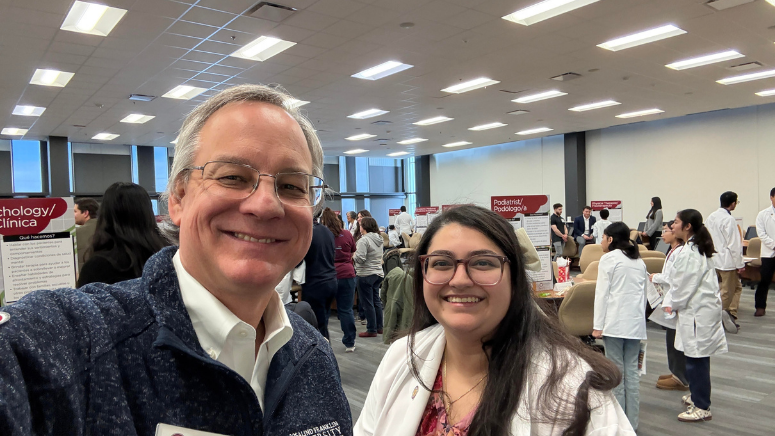
One of the biggest pleasures of my job is watching the students flourish. Last weekend, I had the chance to join the Mini-Medical School (MMS) science fair and then the career fair for MMS students from the area. Both events were run by our students. For the science fair RFU students worked with the middle schoolers each session to help them create a poster about a particular disease. I had the chance to have a “tour” of strep throat and osteoporosis posters among others. It really was a delight for the adults in the room - I do not pretend to understand middle schoolers now or when I was one of them.
The career fair included posters and presenters from professions in each of our colleges and community partners. There was even a professor profession table! I think I visited each of those tables and met with our students and faculty who gave up a significant chunk of their Saturday to talk to the middle schoolers and their adults (the Parent/Hero Academy). I continue to be impressed by the amount of volunteer work the people of RFU do. We are not that big, but nearly 500 people volunteer at the Interprofessional Community Clinic to provide care to people who deserve care but our society is ignoring their health needs. I was impressed by the sheer scale of the career fair and the number of RFU students, faculty, and staff working to help create opportunities for our neighbors.
Congratulations to Associate Professor Shawn Flanagan on receiving notification from the Defense Health Agency that his proposal entitled ‘Urinary Proteomic Biomarkers of Adaptive Bone Formation and Stress Injuries in Military Recruits’ has been recommended for funding.
If you have spent much time in academic health, you will soon sort out that ours is a small world. As proof, it turned out that this week’s speaker for the Women in Science and Healthcare series was a former student of mine, Shikha Jain, MD, who presented on “It's Not You: How Systems Produce Impostor Phenomenon.” We all have heard of “imposter syndrome” as the sense that we are not prepared for or worthy of our opportunities. Of course it is not a syndrome, which makes it appear to be something of an illness - like we have something wrong with us. Rather, Dr. Jain, building on the work of Pauline Clance, PhD, points out this experience is a phenomenon born out of how we treat each other and borne more frequently by women and minoritized populations.
Addressing imposter phenomena requires a welcoming, supportive, and collaborative community. Creating that community is partly policy-based. For example, tenure rules can be made flexible enough to address the minority tax or to automatically provide extensions for illness or parenthood. Those kinds of policies help everyone reduce institutional structural barriers to success. Further, a great deal of addressing imposter syndrome depends on addressing how we treat each other: whether we are welcoming and how we mentor and sponsor each other. It was that community building emphasis in Dr. Jain’s talk that brought me back to the Mini-Medical School events of the weekend and particularly to the career fair. It is rare and special that so many of our people volunteer together to advance the opportunities for our young neighbors. Events like last weekend do not resolve the largest societal issues that make people feel unwelcome, but they are part of the grassroots solutions. I hope our neighbors see that they are welcome to be with us on campus and in our professions.
Improving the wellness of all people with you,
Aron