
View Related Pages
From Aron’s Desk
March 13
Friends,
Over my four months, I have tried to meet as many people from the university as possible, including alumni. Last week, I made my first alumni trip to join a gathering of graduates in the Los Angeles area. The Institutional Advancement (IA) team, led by George Rattin, did a great job setting up meetings and events, and Southern California did a great job with the weather. Although the main purpose of my events was to introduce me to our alumni networks, George’s team and Dean Chatterjee had good success in securing donations during their visits. I was so impressed with our alumni, their careers, and the work they do. There is a special pride our alumni have in their colleges and the university that is compelling and energizing - my thanks to everyone who met with me and to the IA team who put it all together.
This is my first budget cycle at the university, and I have been impressed by the collaborative nature of the process and how much work the staff and faculty put into the effort. You can read the “newspapers” and immediately grasp how healthcare costs are changing the budget picture facing organizations. For RFU, healthcare costs are up about a million dollars over last year, and most of that increase in expense is from prescription drug usage, including the GLP-1 medications used for diabetes and weight loss. Several years ago, the board set a goal of getting to a break-even budget over several years, and the FY27 budget we are working on is the year we are to close the final gap, which was about $1 million last year. You can imagine that another million increase in health expenses does not make that easier. We are getting close, and I appreciate all of the creativity we have demonstrated in creating new programs and revenue and the sacrifices people have made in reducing expenses to help us approach break even. It is very hard to make meaningful investments for the future when we are borrowing future money for operations; we are getting close.
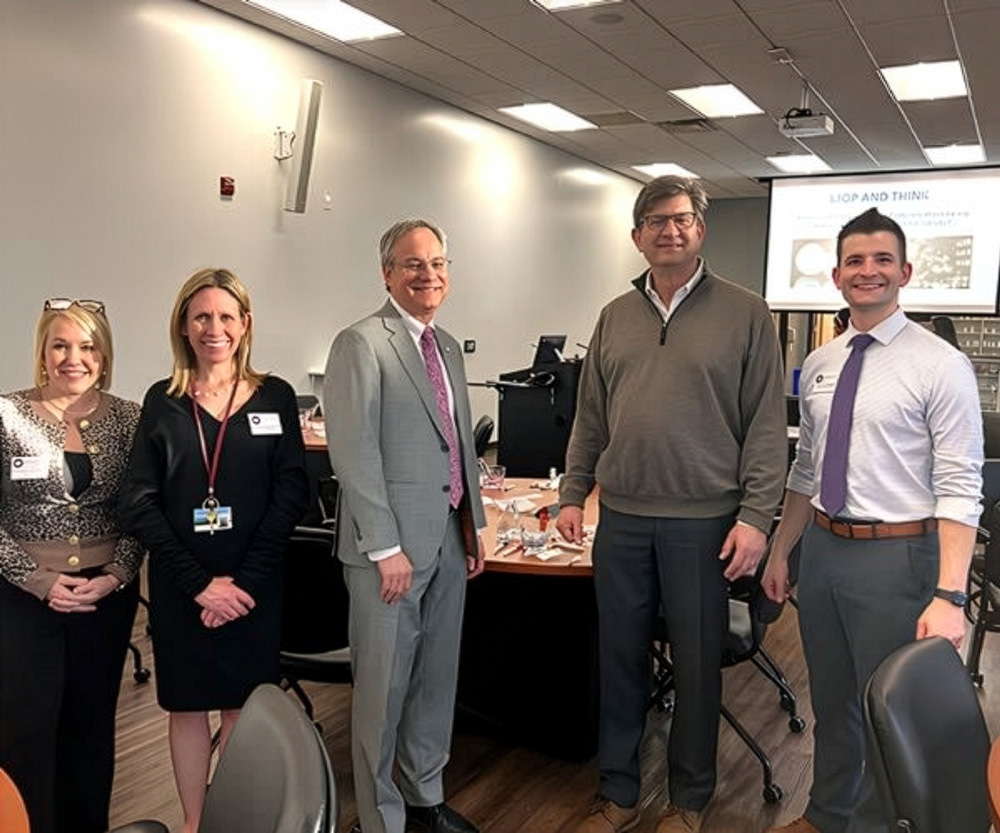
You will recall that I visited the staff of our congressional delegation in Washington, DC last month, and this week Representative Schneider and his local staff visited RFUMS as part of the 10th District STEAM Scholars Program, which gives Lake County high school students a chance to learn about STEAM (Science, Technology, Engineering, Arts, and Math) topics and fields at sites around the district. The Congressman and his team were great and clearly appreciated their time at RFU.
Our College of Pharmacy took the lead for us this week and introduced the students to how prescriptions are compounded and dosed using candy, water, and syringes. In one remarkable demonstration led by Sean Kane, PharmD, the students measured out about 500 mg of drink powder. (That nostalgic spasm ignores how much I dislike the taste of the stuff - stay in school, kids!) Anyway, 500 mg is about one eighth of a teaspoon (a dash). That’s the amount of Tylenol in an extra-strength tablet. If you divide that amount in half, and in half, and in half, and in half, and in half, you have a common adult dose of oral morphine (about 15 mg or 1/40 teaspoon), which is more than enough to produce an analgesic effect. Then divide it in half again, and half again, and half again, and that amount (about 2 mg or 1/256 of a dash) is easily a lethal dose of fentanyl for an adult. Cut it in half another five to six times, and that is about the usual therapeutic dose (roughly 25-50 micrograms) used for pain relief. (Exponential growth is amazing.) It is the incredible potency of fentanyl that makes it so easy for drugs laced with fentanyl to kill people. Kudos to Kristen Ahlschwede, PhD, and Sean Kane, PharmD, for the great job they did with the students. And, my thanks to Rachael Lange, director of our pathways initiatives, Nick Kallieris, associate vice president for government relations, and the dean of our College of Pharmacy, Kristin Wiisanen, PharmD for getting the whole visit set up.
Each week, I have the opportunity to witness another remarkable collaboration between RFU and our community. This week, I attended the community session of the Principles of Professionalism, Health Care, and Health Equity course. The classroom has about 30 eight-person tables, each with a group of RFU students and a representative from one of the community partners. Each table had a conversation with its community leader, then rotated to another table. The world is rough, so it was heartwarming to see the students engage with these community leaders, who share their passion for helping those around them.
Improving the wellness of all people with you,
Aron