View Related Pages
From Aron’s Desk
June 12
President’s Wife’s Update
Alice Dreger, PhD
When Aron accepted RFU’s offer of the presidency last year, the reaction of my friends was uniform: They asked me to convey their congratulations to him and then quickly noted that I’m totally unqualified to play a First Lady. I do bear a vague resemblance to Eleanor Roosevelt – my teeth are kind of horsy, my hair impossible, and, like she did, I believe people should try to use their privilege in the service of the public good. But it’s also true that typical First Lady attributes like “gracious” and “classy” are not adjectives commonly used to describe my character. No wonder that one of my friends asked me if an actress would be hired to play me at fancy RFU receptions.
That said, I do bring something useful, and that is that I am a professional writer and historian of medicine, which means that, when Aron is having one of those weeks like he is presently – where he did a lot of interesting and useful things, but isn’t sure how it all coheres into a 700-word Friday update – I can lend a hand.
First off, if you’re wondering where Aron was last week on his vacation, allow me to report that he spent a chunk of it canoeing the Pine River in Michigan with our son Kepler and one of Kepler’s friends. Aron got caught in a “strainer” (a downed tree that treats you like a string bean in a colander) and ended up in the drink, but he lived to tell about it – and also to bake bread over the campfire that night, because he’s just nuts enough to make fresh bread while camping. This weekend, we’ll enjoy a tamer get-together with Kepler, who is turning 26. While he is now a PhD student in Molecular Engineering at the University of Chicago, he’s still the railfan we turned him into when he was a toddler, so we’ll be spending one or two days at the Illinois Railway Museum with him.
In terms of RFU-related family news, I’m pleased to tell you that the scholarship Aron and I have endowed at RFU has officially come together and will soon be providing a four-year $10,000 per year scholarship to a Dr. William M. Scholl College of Podiatric Medicine student in financial need to support their journey to become a podiatric physician. The scholarship is named for the Domurat Family, in honor of my mother and her kin, a clan known for its perseverance, good humor, and value of education.
When we decided to name the scholarship in Mom’s honor, we gave her the choice of which degree to support. If I showed you a picture of my mother’s feet – which I am sparing you in case you’re eating while reading this – you would see why her choice makes perfect sense. But seriously, regardless of how her dogs look, thanks partly to wonderful podiatrists, the old grey mère is still walking to and from church at 90, when it’s not too hot or cold out anyway.
My mother’s experience was like many women of her generation: while she managed to earn a bachelor’s degree – in her case, in philosophy at Hunter College – she soon got stuck being a frustrated housewife. I benefitted from her skipping children’s stories in favor of Strunk and White’s Elements of Style and the dialogues of Plato, but I mostly benefitted from her insistence that I gain a real profession. Like many women, when her parents aged, Mom found herself shifting from childcare to elder care. Her mother had the diseases that come with diabetes and alcoholism, and her father developed severe Parkinson’s during the Wild West days of L-Dopa experimentation. During all that, my dad developed M.S. Having mastered injections and GI tube feeding and the like, by her early 50s, she realized she might as well get a nursing degree, and within a couple of years of hard work, she could write “LPN” after her name. Always a force to be reckoned with, she learned to drive stick-shift around the same time.
Having a scholarship that is basically named after her feels right, because any student that manages to follow in her path will not only complete what they set out to do, but will know the importance of holding a patient’s hand, of speaking truth to power, and of being there for the late shift. We haven’t been with RFU long, but it’s already clear this is the kind of place where students learn these things.
Aron may have already mentioned to some of you that, just before he was offered the position, he and I snuck on to campus to get a feel for the institution. As we walked around, we found ourselves confused about what belonged to RFU. Was there really a small lake with koi, and were those old buildings on the campus? The sudden appearance of two northern flickers delighted us, as we rarely saw them in Michigan. Then we saw enormous numbers of what appeared to be dormitories, and Aron talked with some trepidation about how he had never been in charge of that many buildings all at once. As we walked further, we realized with some relief and a lot of laughter we had mistaken the naval base for part of RFU. The flickers happily remain with us.
The weather that day was warm and sunny, and a group of students were out playing soccer together. The scene was wonderful – young people with diverse heritages and accents having fun together, on break from their studies. I was reminded of it when, this spring, I had the honor of giving a guest lecture for the joint PharmD and MD ethics course taught by Amanda Lund and Catherine Deamant. My theme was how reasonable people have done some pretty terrible things in the history of medicine; the intended lesson was the importance of humility and reflection. The students did a marvelous job unpacking the problems put to them, many of them speaking about the values and habits of their familial cultures to illustrate the challenging subjectivities that pop up in real clinical practice.
This generation of young health professionals is certainly different than ours was at their career stage. Where Aron carried around a homemade notebook of clinical pearls when he rounded as an M3 and M4, today’s students have the world of information at their fingertips, and AI offering to help them make sense of it. They were born into a truly global culture, and will work in an age where power in healthcare systems has shifted dramatically away from the white coats in favor of profit-seeking corporations and relief-seeking patients.
But I could see in the ethics class that RFU students are, fundamentally, as Aron was in medical school, and as my mother was in nursing school: eager to do the right thing and to do it well, in the service of care. In spite of so much badness in the news every day, it’s that orientation that makes one feel quite hopeful about humanity. It’s what puts the spring in Aron’s step as he heads to that campus with its flickers.
We’re so happy we’re here. Thank you.
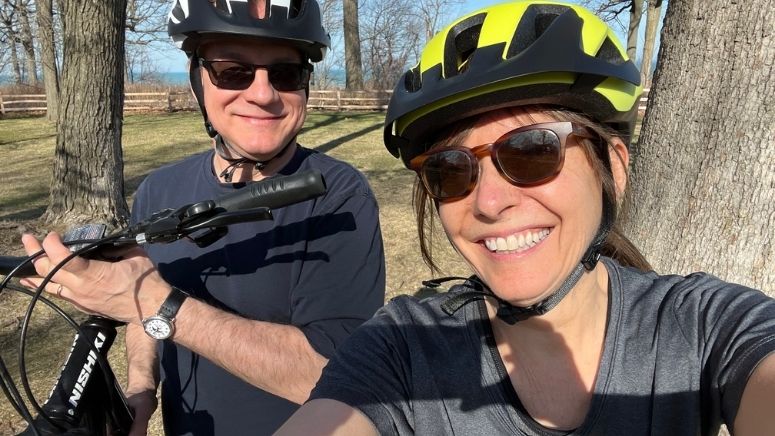
Photo credit: Alice Dreger.