View Related Pages
From Aron’s Desk
August 7
Friends,
Our students are back, and this week I have had the pleasure of briefly welcoming our newest learners to our amazing university and the great work our people do - great work they will join because they came to learn with us.
Our students come to Rosalind Franklin University of Medicine and Science to become great clinicians and scientists. They arrive with their own individual stories, experiences, purposes, families, skills, and knowledge. After their time with us, they return to the greater world as the same wonderful people who came here changed, we hope, in only the very best of ways through their education. They may not always get the chance to sleep but they will be changed - learning is a physical process of changing our brains.
Education is not magical, it is the result of the right kind of work in the right setting that productively changes the brain…and some other parts of the central nervous system, and parts of the peripheral nervous system, and maybe other stuff too. People and sea slugs use the same mechanisms for some kinds of memory and learning. Rest on that for a moment my fellow wanderer. Powered flight has independently evolved in insects, mammals, non-bird dinosaurs, and birds, at a minimum. And seeing using light has so many evolutionary paths that I am not even going to try and summarize them. The mechanisms of memory at the core of learning systems are very, very old and highly conserved in evolution. And, while my hope is that everyone will follow their curiosity through these evolutionary tangles for fun and silliness, my main point is that these are fascinating and special ways organisms interact with their environment. Learning happens when we meet the needs of ourselves as organisms and create the right environment.
No one will be surprised by the organismal needs or environmental settings that encourage learning. In general, adequate nutrition, sleep, safety, and exercise all help learning. A little bit of stress is good, a lot of stress is bad. Repetition, multiple sensory inputs, new geographical locations, and proximal exercise all help learning. Emotional engagement is a powerful driver of memory. Connecting new memories to an infrastructure of existing memories is very useful for learning.
Our new students are headed into some deep water. Across the land the first year of health education programs is tough on students. The content is not generally harder than what is taught in college, but there is so much content that the studying systems people use in college are often overwhelmed in health professional schools. The feedback feels different too. All of our students have spent their academic careers being well above average, and in our programs half of them will be below the median. That is not an easy adjustment for many students.
As a university, we provide many supports for students: from exercise facilities to tutoring, from clubs to counseling, from music to mentoring, from art to emergency food. Students also need support from their friends and families, and we need students to look out for each other. We cannot help if we do not know someone needs help. They cannot learn well if their basic needs are not met - we are here to help.
In my life and from what I have seen in the successful people around me, it is essential that people enjoy at least some part of their work each day. It does not all have to be fun, or maybe no individual part of the work is a joy but the process as a whole is fun. The path to becoming a scientist or a clinician is too long and difficult to not enjoy the work along the way. There are many kinds of useful, noble work in the world; join us because you enjoy this path.
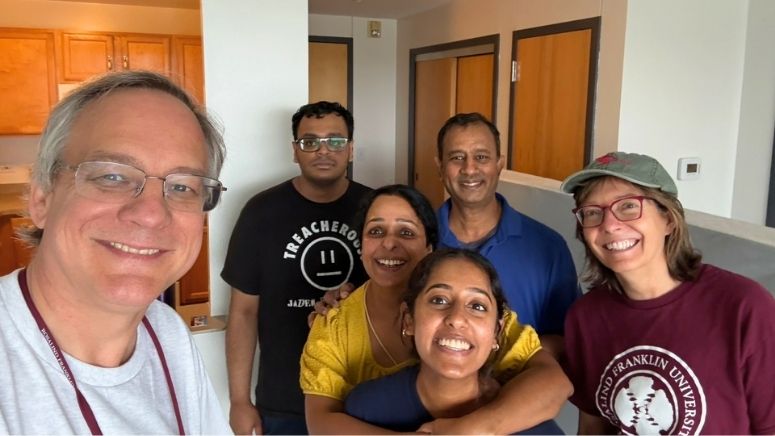
The enthusiasm of our new students is a delight, and I got a little taste of that during move in. I had the chance to meet some of our newest students at the move-in registration tent, and a few more when Alice and I helped move some furniture and boxes. The weather cooperated for the most part; Dean of Students Shelly Brycki and her team did a great job with organization and trouble shooting. I’ve been places where move-in does not compare favorably to a scrum. Move-in is wonderfully different here.
Let me transition briefly to a more specific set of issues - health coverage. You all know that many universities are facing a range of financial challenges. Everyone has seen news about redundancies and cuts. We have been working to get to a break-even over the last couple of years, and our success has taken sacrifice. As we do our final accounting for last year, I am optimistic we met our FY26 budget goals. And for FY27, our board has passed a break-even budget. The largest new challenge in our finances was a proposed 28% increase in our health care costs from our insurer. Over the past weeks, I had useful and insightful conversations with the faculty senate council and our community during the recent town hall. Those conversations had an impact on our approach to meeting the financial challenge of increasing health care costs this year and in future years. Open enrollment starts near the end of August with the package of changes and supports we discussed, which will limit the university’s increase to 21%. Meetings will be held in-person and virtually the week of August 17 to share these important updates... Watch for communications from our HR team regarding these important meetings.
For our faculty, staff, and students to be successful, every part of our mission has to work and that takes many kinds of resources. Some of our focus will have to remain on managing costs, but we are in better shape than many of our neighbors, because our programs are healthy. Schools around us have laid off faculty and staff as a result of low enrollments or loss of international students, but our programs have continued to be strong thanks to the talent, dedication, and hard work of our staff and faculty. In fact, this is our best enrollment year ever - those are the students we’ve had the pleasure to welcome this week. Our students join us in the noble work of health universities - making the world a better place through education, innovation, and caring for our neighbors..making life in discovery.
Improving the wellness of all people with you,
Aron