View Related Pages
From Aron’s Desk
November 6
Friends,
This week, I have been traveling to meet with friends of Rosalind Franklin University of Medicine and Science. This is always a pleasure for me. As an example, I had dinner on election night with Evelyn Lewis, MD, ’83. We talked some about the election, but mostly we talked about her work across the nation in support of veterans. (You can learn more about Dr. Lewis’ work in our MLK Town Hall from last January.) She has developed resources for mental health and benefit navigation that she self-funds. It was inspiring and led me to think about how our university can collaborate in the work of alumni, students, and faculty.
If you’ve heard me talk about the university to alumni or community audiences more than once, then you had to repeatedly listen to me talk about our student-led free clinic, the Interprofessional Community Clinic (ICC). I’m more than a recursive algorithm; I am a broken record. For those of you who have missed my spiel: we have one of the best student-run free clinics in the country. More than 400 students donate their time each year, and the clinic offers a much broader group of services than other free clinics. The ICC astonishes.
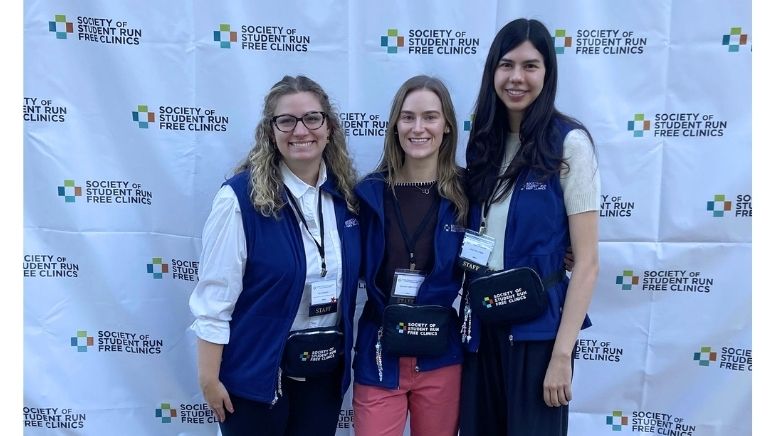
Our ICC student leadership recently attended the national Society of Student-Run Free Clinic (SSRFC) conferences in Southern California. Our students lead within the SSRFC national network as does the ICC’s medical director, faculty member Melissa Chen, MD, leads the national faculty association (SRFCFA). Yovanna Pomarico PhD MBA CMA co-chaired the SRFCFA’s faculty development committee and Misty Fils DMS, PA-C served on the conference planning committee. This is one of the areas in which our university provides national leadership. I asked three of the students at the conference to write a paragraph reflection about their experience at the meeting, to wit:
- Mia Fidanze, CMS ’27
Technology Chair, SSRFC National Operating Committee
Serving on the Operating Committee for the past two years taught me the value of collaboration in advancing health equity. Organizing the annual conference required significant administrative effort, but seeing that work translate into meaningful connections between student leaders and clinics nationwide made it incredibly rewarding. The opportunity to exchange ideas, share successful initiatives, and learn how other clinics addressed similar barriers to care reinforced the impact of bringing together individuals with a shared mission. Through this experience I came to appreciate how creating spaces for collaboration can extend the reach of local initiatives and strengthen our collective ability to serve underserved communities. - Lana Trautman, CMS ’28
Conference Coordinator Elect, SSRFC National Operating Committee
Last year, I had the opportunity to attend the Student-Run Free Clinics (SSRFC) Conference as a representative of the Interprofessional Community Clinic. It was an incredible experience connecting with students from free clinics across the country, exchanging ideas, and learning from one another about ways to advance health equity and improve the quality of care we provide to underserved communities. This experience inspired me to become more involved with SSRFC, and I joined the Operating Committee as Conference Coordinator Elect. Over the past year, I have gained valuable experience collaborating with a dedicated team to plan and execute a large-scale national conference. One particularly meaningful aspect of our work this year has been strengthening SSRFC's international connections with student-run free clinics in Canada, Europe, and Africa. Through these relationships, we have been able to share resources, exchange ideas, and learn from the unique approaches clinics around the world take to addressing healthcare disparities in their communities. At this year's conference, we had the opportunity to hear from experts in street medicine and community health, explore innovative approaches to addressing healthcare disparities, and reflect on what it means to be an effective healthcare provider and leader. It was especially rewarding to see the conference come together and witness the enthusiasm and commitment of students passionate about serving their communities. I am excited to step into the role of Conference Coordinator this year and continue building on this experience by fostering collaboration, highlighting the incredible work of student-run free clinics, and expanding opportunities for clinics across the country and around the world to connect, share knowledge, and work together toward more equitable, high-quality healthcare. - Delaney Griffiths, CMS ’27
Finance Chair, SSRFC National Operating Committee
As the 2024 President of the Interprofessional Community Clinic, one of my greatest takeaways from the position was learning what it takes to successfully implement initiatives that advance health equity. At the Society of Student-Run Free Clinics Conference, students have the opportunity to share their research, projects, successes, and failures in addressing barriers to care. I came to appreciate how this exchange of knowledge and experience can strengthen individual clinics while ultimately contributing to healthier communities nationwide. As the elected National Finance Chair, I focused on fundraising and grant attainment, recognizing that even the most innovative, well-researched, and effective initiatives cannot succeed without adequate funding and strategic resource allocation. This year, our Operating Committee developed its inaugural Street Medicine Grants to support clinics in expanding services and advancing community-driven initiatives. Reading the applications and learning about student leaders' plans to strengthen local advocacy and address disparities was particularly inspiring. It was equally meaningful to help provide the resources that could bring these ideas to life.
Health equity can be challenging to teach in a classroom, but the Society of Student-Run Free Clinics Conference makes it tangible. Through mentorship, collaboration, and access to resources, students are empowered to translate their commitment to underserved communities into meaningful action. This experience reinforced my belief that investing in student leaders and their initiatives is an important step toward ensuring that equitable healthcare access remains a lasting priority in future physicians' practices.
The week brought hope that the infrastructures around vaccination, education, science, and treating our neighbors as we would like to be treated might improve. Still, working to make the lives of the people around us better will require attention, focus, and more work. Hopefulness makes change possible, but possibility cannot overcome entropy without our energy. Creating educational opportunity, creating new knowledge, expanding access to care, and improving the lives of our neighbors is the work of institutions like ours; thank you for joining in this noble work.
Improving the wellness of all people with you,
Aron