View Related Pages
From Aron’s Desk
May 15
Friends,
I take real joy in learning about the creative innovation that happens at Rosalind Franklin University. I am delighted but not really surprised there is so much - creativity and innovation are the fundamental chords of a university. Our people are here to be creative and innovative, as our historical colleagues have been since the onset of the Enlightenment. That creativity spans our work, from the way we manage our facilities to the discoveries made in our laboratories.
I’ve been thinking about how institutions support creativity, or contrariwise, since meeting with K. Michael Welch, MB, ChB, FRCP, our former president, early in the week. He was president from 2002 to 2018, and he saw some stuff in that time. In many ways it was his creative vision, and he would be quick to say that vision was from the whole team, that we see at the university today. Under his leadership our governance was restructured, the Innovation and Research Park was designed and built among many other building projects, the university began its nation leading focus on interprofessional education, the student run clinic was born (which I think may be the best clinic of its kind in the country), and we were reborn as Rosalind Franklin University of Medicine and Science. That is a lot of creation and creativity; my list here is a scant summation, a leek without a dragon.
My mind turned to creativity for other reasons as well this week, namely, the salon release of Synapses 2026 Volume, which is just a joy. If you have the chance, be sure to congratulate the team (Editor-in-Chief Brenda Affinati, MD, Managing Editor Candice Kosanke, Curator Kelly Reiss, and the founder, Nutan Vaidya, MD.) You can also listen to the 10th Annual Synapses Salon event here. I am particularly enamored with the confluence of faculty, staff, alumni, and students who submit and publish prose, poetry, and visual art in the volume each year. You will recall Dr. Joanna Dabrowska’s piece, Dr. Rosalind Franklin Polychromatic, from the 2025 Volume, was reformulated for my office.
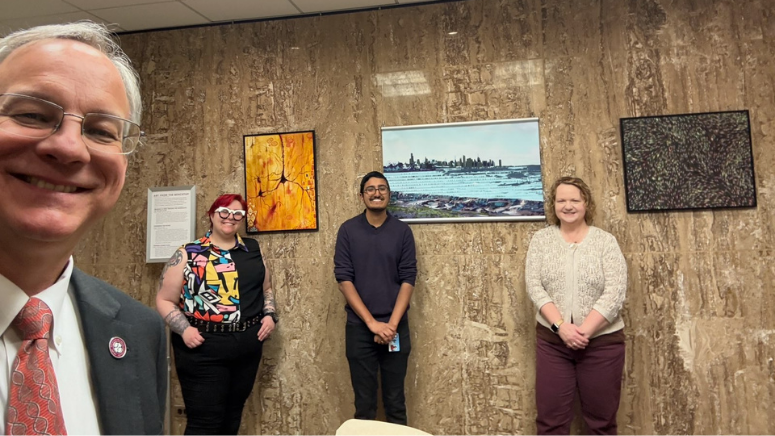
A treasure of my week was meeting with GM O’Hare MS ’25, CMS ’29, Viral Mistry, PhD ’25, and Emily Reisenbigler, Sr. Research Specialist, about their pieces Neurons As Seen through the Microscope of Golgov Klimt (O’Hare), Pondering the Waves (Mistry), and Forging Connections (Reisenbigler) from this year’s Art from the Benchtop. You can read about the pieces here. Learning and discussing the story behind each piece, and the way each of these scientists thinks about art, was a great break from a day of spreadsheets and policies, not that there is anything wrong with that.
Perhaps most true to the mission and scope of a great university like ours, my week started with the Health Equity Breakfast, which focused on innovative ideas and programs we do with and for our neighbors. It was a great event put on by our team in Institutional Advancement and moderated by the director of our Michael Reese Foundation Center for Health Equity Research, Dr. Amanda Simanek. If you are a regular reader of this update, you know these programs:
- The nation leading, student run and led free clinic - the Interprofessional Community Clinic
- The Rosalind Franklin University Children’s Advocacy Center Medical Clinic
- Supporting Moms and Babies
I will not subject you to a repeat recapitulation of these programs - follow your curiosity in the links. But, I will say that each of these projects is an example of our university creating innovative programs for the benefit of the communities around us. Education and discovery get much of the attention from the media, but academic faculty, students, and staff also create remarkable solutions that help our neighbors in need.
At the end of the event, we gave people a chance to get a sneak peak at the Virtual Health System. We are moving equipment into the space this week, and we will start its sea trials next month before a formal opening in the fall. I have planned and developed three simulation centers in my career and visited TNTC simulation centers over the years. Ours is excellent and will provide a very special, interprofessional experience for our learners. It is another example of how innovative and creative our people are - kudos to Dr. Jim Carlson, our interim provost, the team in the DeWitt C. Baldwin Institute for Interprofessional Education, who staff our simulation work, and all of the faculty, staff, and students involved in the planning and implementation of this creative and innovative space that will benefit our learners and their patients for decades to come.
Improving the health of all people with you,
Aron